Musical Mirror
philosophical and poetic thoughts on music
A letter from Raymond Scott
In this letter, one of the greatest composers of the last century
talks to us about the Circle Machine.
Raymond Scott was a decidedly forward-thinking personality,
but also very attentive to the practical and work-related aspects of his profession.
He invented the sequencer as we know it today before anyone else, he understood that it was an advantage to have it for his work as a composer of commercials and had no intention of divulging his invention.
I find the friendship with the young Robert Moog extremely fascinating, as he very soon changed the concept of the synthesizer forever.
Published in Electronic Music magazine, December 2001
Gentlemen:
I have a story that may be of interest to you.
It is not widely known who invented the circuitry concept for the automatic sequential performance of musical pitches—now well known as a “sequencer.”
I, however, do know who the inventor was—for it was I who first conceived and built the sequencer.
Bob Moog, who visited me occasionally at my lab on Long Island, was among the first to see and witness the performance of my UJT-Relay sequencer.
To digress for a bit: I was so secretive about my development activities—perhaps neurotically so—that I was always reminding Bob that he mustn’t copy or reveal my sequencer work to anyone. I understand, now, my personal need for secrecy at that time. Electronic music for commercials and films was my living then—and I thought I had this great advantage—because it was my sequencer.
Word naturally got around about the nature of what my device accomplished, but Bob Moog continued to be loyal. I must say Bob Moog is a most honorable person. He steadfastly refrained from embodying my sequencer in his equipment line until the sheer pressure of so many manufacturers using the sequencer forced him to compete. Yet, he used the simplest version, though he knew about my most advanced sequencer. Quite a gentleman, and a super talent besides.
Now, with the passing of years, I guess I regret my secrecy and would like for people to know of what I accomplished.
– Raymond Scott, ca. late 1970s
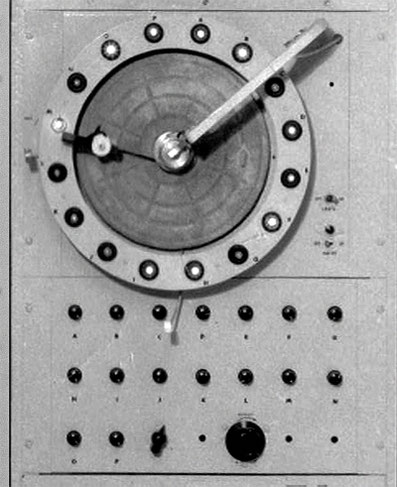
I've always found the Circle Machine to be a mystical, fantastical object, capable of transcending time. Its use in the Manhattan Research, Inc. experiments profoundly changed my musical perception and opened up new expressive possibilities.
For this reason I wanted to recreate a digital version using Max for Live. I also wanted to bring a little of Raymond Scott's world into Ableton.
You can download Circle Machine directly from this site at this link
https://www.remodevicocomposer.eu/maxforlive/circle-machine/
to try to experiment at least one of the techniques that Raymond Scott gave us in his experiments.
