Musical Mirror
philosophical and poetic thoughts on music
How Your Voice Can Trigger a Sampler
In this article we focus on the specific case of the Max for Live device for Ableton called E.VO.E (Every Vocal Event).
The voice is an incredible instrument — the oldest, the most beautiful, the most human.
Controlling a sampler with the voice can potentially contribute to that process of humanizing electronic music, which should remain an open dialogue between technology and composers.
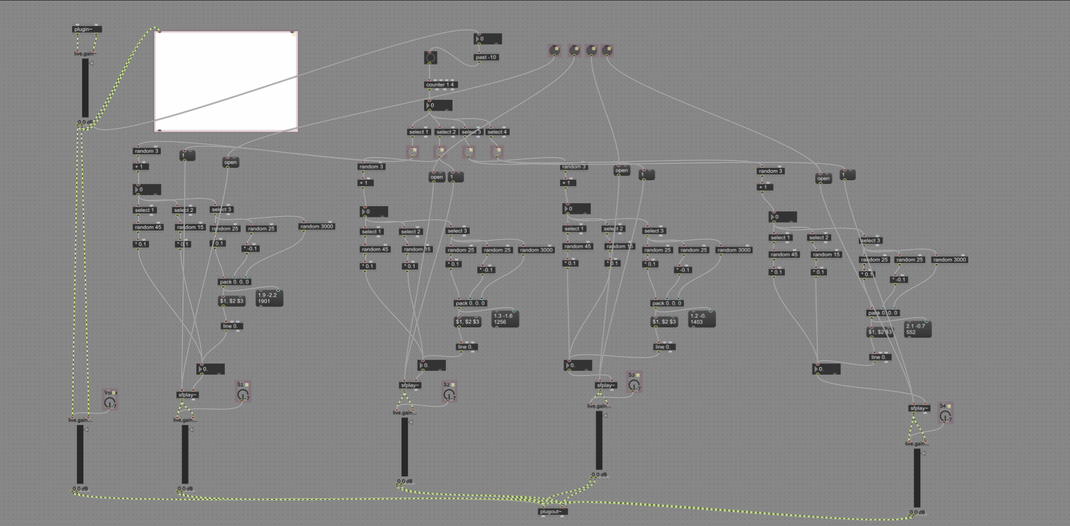
This is the patch behind the functioning of
E.VO.E.
As we can see from the image, the microphone input enters a slider that controls a gain. From one of its outputs we extract the decibel value of the microphone input.
Every time the value exceeds –10 dB, which is reasonably high to avoid unwanted sounds, the signal triggers a counter.
Our peak value for the bang is –10 dB; we can of course choose different values. A higher value will require louder sounds to activate the chain, while a lower value could be used to let the
algorithm interact with, for example, a soundscape where there are no particularly significant sound peaks.
The counter activated by the gain counts endlessly from 1 to 4.
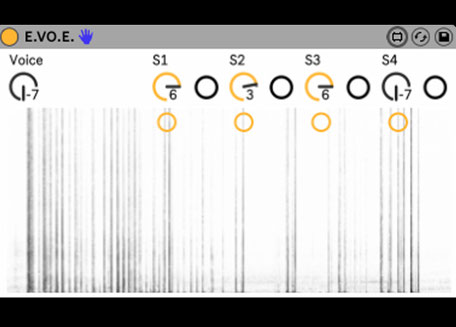
There are indeed 4 samples that can be loaded into E.VO.E.’s
sampler.
By pressing the black circular buttons, you can load any sample of your choice from your sound libraries.
If you don’t have sample packs, don’t worry — check out my Sample Packs.
Even though the number of samples is not very high, we will see how the sonic possibilities are quite varied thanks to the algorithm’s random section.
Moreover, the number 4 evokes many instruments of the past that offered 4 available tracks
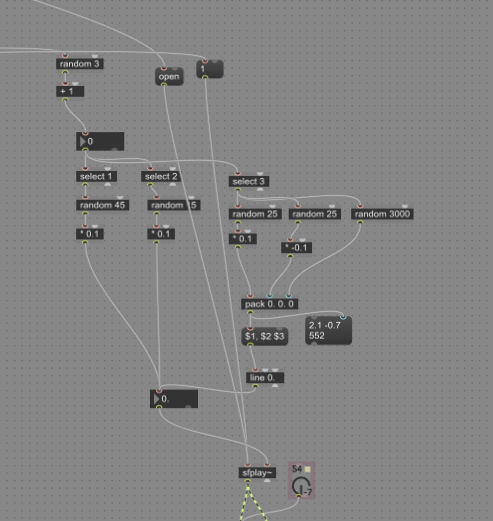
As we can see from this second image, the second part of the algorithm concerns the random section that transforms each sample into multiple developments, practically never repeating
itself.
Each time the sample is triggered, it can randomly take three possible paths.
In the first path, the pitch can vary significantly toward higher tones, resulting in faster playback speeds.
In the second path, the pitch has lower values, so the sample will be altered only slightly — but enough to create timbral and dynamic changes.
In the third path, the pitch moves from high to low, even reaching reverse, within a random time interval that can last up to 3 seconds.
This small experiment, which resulted in the creation of a Max for Live device, shows us how truly infinite the possibilities of the
voice are.
Beyond harmonic, rhythmic, and especially melodic possibilities, we can also think of the voice as a form of controller.
Moreover, it could be useful in other contexts, such as theatre, where an actor could trigger sounds through different dynamics, or in certain sound-poetry experiments.