POINTILLISME
POINTILLISME
Interactive Graphic Score & Serial Music Generator.
POINTILLISME
Generative quartet for four oscillators · graphic score · série intégrale
What is integral serialism?
In the early 1950s, a group of composers gathered at the Darmstadt summer courses set out to do something radical: extend the twelve-tone method far beyond pitch alone. Where Schoenberg and Webern had serialized the order of notes, the new generation — Boulez, Stockhausen, Berio, Nono, Ligeti, Pousseur — began serializing every musical parameter: duration, dynamics, register, timbre, articulation, spatial position. Each parameter received its own independent series, its own ordering logic.
The result was integral serialism (serialismo integrale): a music in which no single element dominates, no hierarchy guides the ear, and no pattern repeats in any predictable way. Anticipated by Messiaen's Mode de valeurs et d'intensités (1949) and proclaimed by Boulez in his provocative essay Schönberg est mort! (1952), it represented the final stage of a process that had begun with Wagner's chromaticism and continued through the emancipation of dissonance in the Second Viennese School.
Stockhausen took this further into what became known as pointillism (musica puntuale): a music where each note exists as an isolated sonic atom — separated from any melodic continuity, freed from harmonic function, suspended in its own acoustic space. The listener, unable to latch onto familiar patterns or tonal landmarks, enters a state of disorientation that is, paradoxically, the point: every sound is heard for itself, in the present moment, without expectation of what comes next.
The instrument
POINTILLISME is a browser-based generative quartet built entirely with the Web Audio API — a single self-contained HTML file, no installation, no dependencies.
Four independent oscillators function as four voices in a serial ensemble. Each voice runs seven independent series that advance at their own pace: pitch (cycling through all 48 row forms — Prime, Inversion, Retrograde, Retrograde-Inversion, each at 12 transpositions), register, duration, dynamics, envelope (ADSR), spatial position (stereo pan), and ornament. Because the series lengths are coprime, the global combination does not repeat for millions of events — an arithmetic property that produces the absence of repetition and hierarchical landmarks characteristic of integral serialism, not as an imposed rule but as an emergent consequence of the system itself.
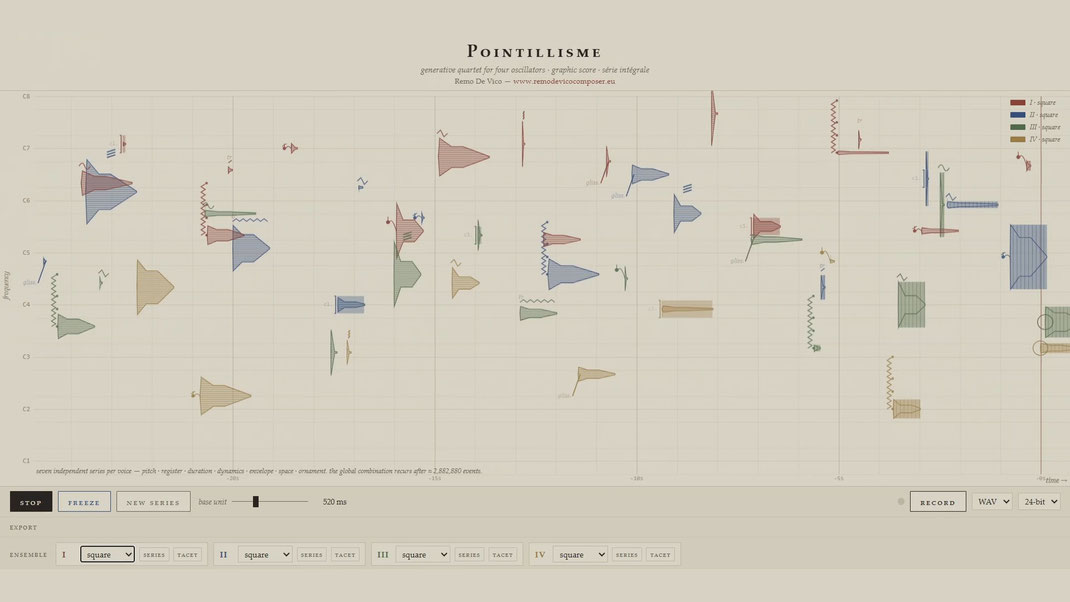
The ornament series draws from ten types rooted in traditional and extended technique: trill, mordent, gruppetto, appoggiatura, acciaccatura, glissando, tremolo, arpeggio, cluster, or none. Each ornament is rendered both in sound and as a graphic glyph on the scrolling score.
The visual output is a graphic score in the tradition of Stockhausen's Studie II and Earle Brown's coordinate notation: time flows horizontally, frequency vertically, each event is drawn as an envelope-shaped figure whose width is its duration, height its dynamics, and profile its ADSR contour. The four voices are distinguished by colour (sanguine, ultramarine, green earth, ochre) and by texture (smooth fill for sine, horizontal hatching for triangle, serrated edge for sawtooth, vertical striations for square). Ornament glyphs appear above or beside each event using conventional notation symbols.
Using POINTILLISME in your music
Compose with it
Press play and POINTILLISME generates a continuous, non-repeating serial texture. Each voice has its own waveform selector (sine, triangle, sawtooth, square) and can be independently re-seeded or muted (tacet). The base time unit controls the pace of the generative process.
When you hear material you want to keep, press record. The instrument captures the full stereo output and all note events simultaneously. When you stop recording, two export buttons appear:
- Save audio — WAV or AIFF, 16-bit or 24-bit, at your system's native sample rate (typically 48 kHz). Ready to drop into any DAW.
-
Save MIDI — a Standard MIDI File (Type 1) with four separate tracks, one per voice (
OSC IthroughOSC IV), each on its own MIDI channel. Drag this into Ableton Live, Logic, Reaper, or any other DAW and each voice arrives on its own track. From there, you can assign your own instruments, edit individual notes, transpose voices, or use the serial material as a compositional skeleton for an entirely new piece. All ornament events (trill alternations, glissando steps, arpeggio tones, cluster notes) are written as discrete MIDI events, so nothing is lost in translation.
Perform with it
The freeze function (button or F key) stops time: the score halts, every event visible at that moment stays exactly where it is, and the canvas becomes interactive. Click any event and it plays — with its original waveform, envelope, ornament, and pan position. This turns POINTILLISME into a live instrument: you freeze a moment, explore its sonic content by clicking individual events in any order you choose, then unfreeze to let the generation continue. In a live performance context, alternating between generative flow and frozen, manually-triggered gestures creates a natural dialogue between algorithmic process and human decision.
Technical details
- Single self-contained HTML file — works in any modern browser, no server required
- Pure vanilla JavaScript and Web Audio API — zero external dependencies
- WAV encoder: PCM, little-endian, 16/24-bit
- AIFF encoder: PCM, big-endian, 80-bit extended sample rate field, 16/24-bit
- MIDI encoder: Standard MIDI File Type 1, 480 ticks/beat, conductor track + 4 voice tracks
- Stereo output with per-voice panning (serialized azimuth parameter)
POINTILLISME is a project by Remo De Vico.
It is part of a series of browser-based instruments exploring the intersection of generative systems, music history, and the Web Audio API.
Included in the download you'll find HTML Instruments,
a Max for Live device that lets you open POINTILLISME directly inside Ableton Live.
It requires Ableton 12 and Max 9.
Alternatively, you can run it standalone (just double click on html file) and route your computer or tablet output to your audio interface, just like any ordinary instrument.